


EPIDERMOID TUMORS
Rare Tumors, Specialized Expertise

OVERVIEW
Epidermoid tumors — also called epidermoid cysts — are rare, benign growths that develop from embryonic skin cells trapped inside the skull during fetal development. They grow slowly over years or decades, gradually expanding as they accumulate layers of skin cells and keratin debris, much like an onion growing layer by layer.
Despite being benign, epidermoid tumors are deceptive. Their slow growth means patients often live with them for years before diagnosis. By the time symptoms appear, the tumor has typically engulfed and displaced critical nerves and blood vessels at the skull base, making surgery highly complex.
Epidermoid tumors most commonly occur in the cerebellopontine angle (the space between the brainstem and cerebellum), the middle cranial fossa, and around the brainstem. They represent only 0.2–1.8% of all intracranial tumors, making them one of the rarest brain tumors.
SYMPTOMS
Because epidermoid tumors grow slowly and conform to the spaces between brain structures, symptoms develop gradually and can be difficult to diagnose. Common presentations include:
Trigeminal Neuralgia — Severe, electric-shock-like facial pain is one of the most characteristic symptoms. The tumor compresses and irritates the trigeminal nerve, which controls facial sensation. Many patients are initially diagnosed with trigeminal neuralgia before the underlying tumor is discovered on imaging.
Hearing Loss and Tinnitus — When the tumor involves the cerebellopontine angle, it can compress the hearing and vestibular nerves, causing progressive hearing loss, ringing in the ear, and dizziness.
Other Cranial Nerve Deficits — Depending on location, epidermoid tumors can cause facial numbness, facial weakness, double vision, difficulty swallowing, and headaches.
Hydrocephalus — Large tumors can block the flow of cerebrospinal fluid, causing dangerous pressure buildup in the brain.
Aseptic Meningitis — If the cyst ruptures or leaks its contents, it can cause chemical meningitis — a painful inflammatory reaction in the lining of the brain.
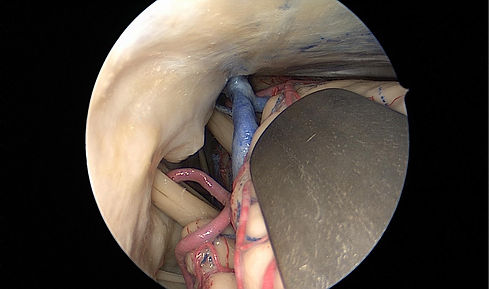

SURGICAL TREATMENT
The primary treatment for symptomatic epidermoid tumors is surgical removal. The goal is complete resection whenever safely achievable, as residual tumor will eventually regrow.
Epidermoid surgery is technically demanding because the tumor capsule — a thin, pearly-white membrane — is often tightly adherent to cranial nerves, blood vessels, and the brainstem. The surgeon must meticulously dissect the capsule away from these structures without causing injury. Incomplete removal is common at centers without specialized expertise, leading to recurrence.
Dr. Fernandez-Miranda's deep knowledge of skull base anatomy — trained under Albert L. Rhoton Jr. — and his mastery of both microsurgical and endoscopic techniques allow him to achieve the most complete resections possible while preserving neurological function. His approach combines the precision of open microsurgery with endoscopic-assisted inspection to identify and remove tumor hidden in crevices of the skull base.
Radiation therapy is generally not effective for epidermoid tumors and is not used as primary treatment.
PATIENT STORY
"For months, I dealt with horrible facial pain until I found out there was a tumor in the center of my head compressing the brainstem and the trigeminal nerve. In desperation, I searched for the best possible expert for my condition and I was so lucky to find DrJFM. He inspired tremendous confidence and genuine expertise. Surgery was a sound success with complete tumor removal and resolution of symptoms. I cannot be happier today. It all looks like a dream now!"
— Michelle Rando, Modesto, California — Epidermoid Tumor & Trigeminal Neuralgia

Frequently Asked Questions
What is an epidermoid tumor (epidermoid cyst)? An epidermoid tumor is a rare, benign growth that develops from embryonic skin cells trapped inside the skull during fetal development. It grows extremely slowly over years or decades by accumulating layers of keratin debris. Epidermoid tumors represent only 0.2–1.8% of all intracranial tumors, making them one of the rarest brain tumors.
What are the symptoms of an intracranial epidermoid tumor? Symptoms develop gradually and depend on the tumor's location. The most characteristic symptom is trigeminal neuralgia — severe facial pain caused by tumor compression of the trigeminal nerve. Other symptoms include hearing loss, tinnitus, facial numbness, double vision, balance problems, headaches, and in some cases, aseptic meningitis if the cyst contents leak.
How are epidermoid tumors treated? The primary treatment is surgical removal. The goal is complete resection whenever safely achievable, as residual tumor will eventually regrow. Radiation therapy is generally not effective for epidermoid tumors. Surgery is technically demanding because the tumor capsule is often tightly adherent to cranial nerves, blood vessels, and the brainstem.
Why is surgeon expertise important for epidermoid tumors? Epidermoid tumors are rare and technically challenging. The thin tumor capsule is often firmly attached to critical nerves and blood vessels, requiring meticulous microsurgical dissection to remove completely without causing neurological injury. Incomplete removal at centers without specialized expertise leads to recurrence. Dr. Fernandez-Miranda's deep anatomical knowledge and mastery of both microsurgical and endoscopic techniques allow him to achieve the most complete resections possible.
Can epidermoid tumors cause trigeminal neuralgia? Yes. Trigeminal neuralgia — severe, electric-shock-like facial pain — is one of the most characteristic symptoms of cerebellopontine angle epidermoid tumors. The tumor compresses and irritates the trigeminal nerve. Many patients are initially diagnosed with trigeminal neuralgia before the underlying tumor is discovered on imaging. Complete surgical removal of the tumor can resolve the facial pain.
Do epidermoid tumors come back after surgery? Epidermoid tumors can recur if residual capsule remains after surgery. This is why achieving the most complete resection possible is critical. With modern microsurgical and endoscopic-assisted techniques, the risk of recurrence can be significantly reduced. Patients require long-term MRI follow-up after surgery.
How do I get a consultation for an epidermoid tumor? Contact Dr. Fernandez-Miranda through drjfm.com or Stanford Health Care at (650) 497-7777. Please provide medical records and MRI imaging. Your case will be evaluated with a recommendation typically within 24–48 hours. Virtual video consultations are available worldwide.
CONTACT US FOR A CONSULTATION OR SECOND OPINION
We will do our best to contact you back within 24-48 hours
CONTACT US FOR A CONSULTATION OR SECOND OPINION
We will do our best to contact you back within 24-48 hours
Please be ready to provide medical records and imaging studies
Your case will be carefully evaluated and will provide our recommendation and eligibility for surgical intervention